
Why You Feel Tired Even When You’re Sleeping
Updated: Mar 26
There’s a particular kind of tiredness that’s hard to explain. You’ve slept a reasonable amount, by most standards, maybe even a full seven or eight hours, and yet when you wake up, something doesn’t feel right. You’re not fully refreshed, not clear-headed, not quite ready for the day. Just… still tired.

It’s a quiet frustration, because on paper you’ve done what you’re supposed to do. You’ve gone to bed at a sensible time. You’ve given your body the hours it needs. And still, the feeling lingers.
“I don’t understand it,” Emma said. “I’m sleeping, but I don’t feel like I’m resting.”

That distinction matters more than it might seem. Sleep and rest are not always the same thing. You can be asleep without your body and mind fully recovering. You can spend hours in bed, but never quite reach the depth of rest that allows you to wake feeling restored. Increasingly, this is what many people are experiencing.
Part of the reason lies in how we live during the day. From the moment we wake up, our attention is pulled outward - messages, decisions, conversations, information. The pace builds quickly and rarely drops completely. Even in quieter moments, the mind keeps moving, planning, processing, replaying. By the time evening arrives, the body may be ready for sleep, but the mind often isn’t.
“I can be exhausted,” Emma said, “but the second I lie down, my brain starts going through everything.”

This state where the body is tired but the mind remains alert is something sleep researchers have studied closely. Even low levels of mental arousal can interfere with sleep depth. A study published in JAMA found that people with higher levels of cognitive activity before bed were more likely to experience lighter, less restorative sleep, even when total sleep time appeared normal.
That matters because not all sleep is equal. During the night, your body cycles through different stages, including deeper phases where physical repair, memory processing, and emotional regulation take place. When the nervous system remains even slightly activated, you tend to spend less time in these deeper stages. So you sleep but you don’t fully restore.
Another important factor is how sensitive your sleep is to what happens during the day.
Research published in journals such as Sleep has described something known as “sleep reactivity” - the extent to which stress and mental load carry into the night. Some people are more sensitive to this than others, but most will notice that even mild stress can lead to lighter, more fragmented sleep.
“I used to think I was just a bad sleeper,” Lucy said. “But actually, I was just going to bed with a busy mind.”

The modern environment adds another layer to this. For many people, the final hours of the day are not a transition into rest, but simply a continuation of input in a different form. Work gives way to scrolling. Tasks give way to screens. Information continues, often at a faster pace.
This matters more than we realise. A study published in PNAS demonstrated that exposure to light from screens in the evening can delay melatonin release and shift the body’s internal clock. But beyond the light itself, it’s the stimulation that keeps the brain engaged. Fast-moving, emotionally engaging content sustains attention when what you actually need is a gradual slowing.
“I thought I was relaxing,” Lucy said. “But I’d be on my phone right up until I tried to sleep. My mind was still active - it had just changed topics.”
Even when you do fall asleep, this lingering activation can continue to affect how restorative your sleep feels. Sleep is not a perfectly smooth process. Throughout the night, the brain moves between different levels of awareness, and small disturbances can trigger brief activations, often so subtle that you don’t remember them.
Sleep researchers have shown that these micro-arousals can fragment sleep architecture, reducing its restorative quality even if total sleep time appears unchanged. You may not wake up fully, but your body never quite settles into the deeper, more restorative phases for long enough.
There’s also something more subtle, and often overlooked - the accumulation of the day.
Modern life leaves very little room for processing. Experiences, conversations, and small stresses build quietly in the background. Without pause, they carry forward into the evening.
And when you finally stop, your mind catches up.
“I didn’t realise how much I was carrying until I tried to switch off,” Lucy said. “It all just came up at once.”
This is what psychologists refer to as cognitive load. Not just major stress, but the constant low-level activity of the mind - things unfinished, unresolved, or simply unprocessed.
Research in Behaviour Research and Therapy has shown that rumination and ongoing mental activity can continue into the night, interfering with the brain’s ability to disengage and transition into sleep.

There are also smaller, practical influences that can quietly affect how rested you feel. Caffeine, for example, can remain in your system for six hours or more, subtly reducing sleep depth. Irregular sleep schedules can disrupt your circadian rhythm - the internal clock that regulates when you feel awake or sleepy. Even small environmental factors, such as light, temperature, or noise, can influence how deeply you sleep.

“I thought I just needed more sleep,” Lucy said. “But actually, I needed better sleep.”
That’s often the shift, from focusing on how long you sleep to understanding how well you sleep. A growing body of research now emphasises that sleep quality - how deep, continuous, and stable your sleep is - can be just as important as total duration when it comes to how you feel the next day.
And this is where the earlier parts of your day and especially your evening begin to matter. If your mind has been constantly stimulated, constantly engaged, constantly “on,” it doesn’t switch off instantly just because you’ve decided it’s bedtime. It needs a transition.
This is the part that’s often missing. Not more effort. Not stricter routines. Just space.
Even a short period of lower stimulation before bed can begin to change the tone of your evening. A few minutes without input, a gradual slowing of pace, a shift away from screens and into something quieter. This allows the nervous system to begin shifting naturally from a state of alertness towards one of rest.
“I started taking ten minutes before bed to just sit and do nothing,” Lucy said. “No phone, no TV. It felt strange at first, but after a while, my mind stopped racing as much.”
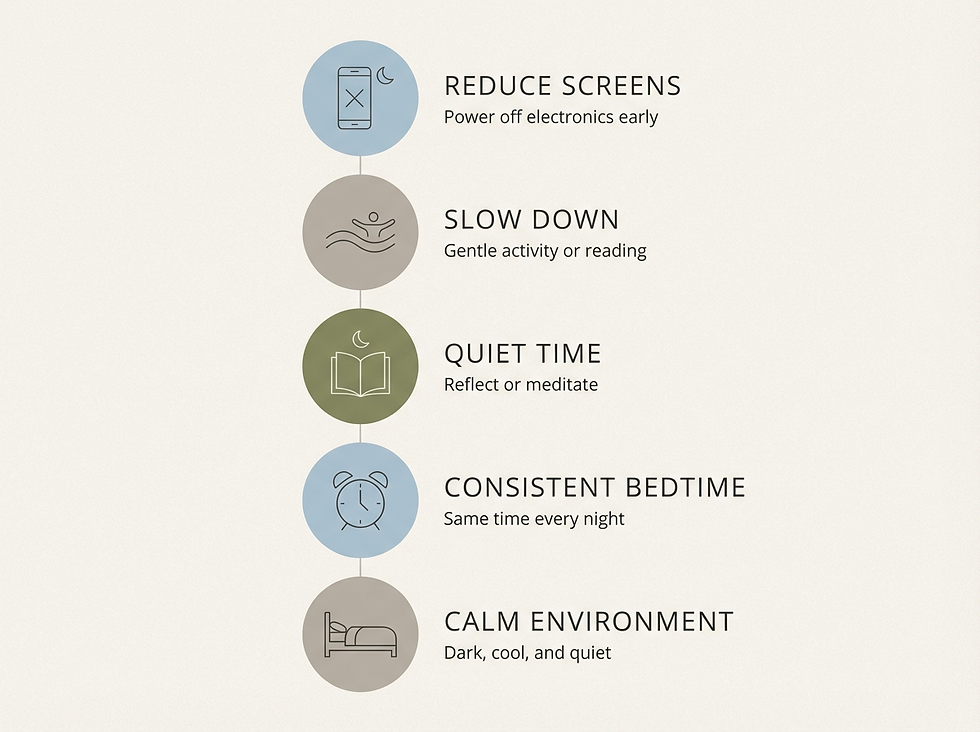
That small change can have a larger effect than expected, because it signals to your system that the day is ending. Over time, these shifts begin to accumulate. Sleep becomes deeper, more consistent, and less fragmented.
You wake up feeling more refreshed, not because you’ve dramatically changed your life, but because you’ve created the conditions for rest.
“I still have the same job, the same responsibilities,” Lucy said. “But I don’t feel as drained in the mornings anymore. It’s like my sleep actually counts now.”
That’s the goal. Not perfect sleep, but sleep that restores.
Wellness doesn’t always come from doing more. Sometimes, it comes from creating the space that allows your body to do what it already knows how to do.
Sleep isn’t just about how long you’re in bed. It’s about how well your mind and body are able to let go.
At Healthier Daily, this is where better sleep begins. Not with pressure or perfection, but with a quieter end to the day and the understanding that rest starts before you fall asleep.


Comments