
Ten Minutes That Change the Day
Updated: Mar 26
There’s a common idea that to feel better, you need to do more. More structure. More effort. More discipline.
But for many people, the opposite is true. What’s missing isn’t another habit. It’s a pause.
Life has a way of filling every available space. From the moment you wake up, your attention is pulled outward. Messages, plans, conversations, decisions. Even the quiet moments are rarely quiet. There’s always something to check, something to think about, something waiting.
And so the mind adapts.
It becomes quick. Reactive. Constantly scanning. It learns to stay “on.”
“I didn’t realise how noisy my head was until I tried to sit in silence,” Mark said. “It felt like walking into a room where the TV had been on all day.”

That’s often the starting point. Not calm. Not clarity. Just awareness. Meditation, in its simplest form, is not about emptying the mind or achieving stillness.
It’s about giving your attention somewhere gentle to rest.
Even for a few minutes. For many people, ten minutes is enough. Not because it solves everything, but because it interrupts something. The constant movement of thought. The steady pull of external input. The feeling that your mind is always slightly ahead of you.
Take Michael, who starts his day early and moves quickly through it.
Emails before breakfast. Decisions before mid-morning. By the time the day settles, his mind doesn’t.

“I used to go straight from work into scrolling,” he said. “It felt like switching off, but it wasn’t. My head was still busy, just in a different way.”
For him, ten minutes in the morning became a small shift.
Not a routine, at first. Just a pause before everything else began. He would sit, coffee in hand, not reading, not listening, just letting the day wait.
“It didn’t feel like meditation,” he said. “But it felt like space.”
Then there’s Aisha, balancing work, family, and a constant sense of needing to stay on top of everything. Her mind rarely stops moving. Lists, reminders, small worries that stack quietly throughout the day.
“I thought meditation meant clearing your mind,” she said. “And I couldn’t do that, so I assumed it wasn’t for me.”

But when she tried again, the approach changed. Instead of trying to stop her thoughts, she let them come and go. Noticing them, but not following them. Returning, gently, to her breath.
“I realised I didn’t need to stop thinking,” she said. “I just needed to stop chasing every thought.”
This is where meditation becomes more accessible. It’s not about control. It’s about attention. The mind will wander. That’s what it does.
Research into attention and mind-wandering has shown that our thoughts drift frequently, often towards the past or future. It’s a natural process, but one that can contribute to stress when it becomes constant or repetitive. Meditation doesn’t stop this. It simply gives you a way to notice it. And, slowly, to return.
For Jonas, whose evenings were often spent moving from one screen to another, the shift came later in the day.
“I realised I never really had a break,” he said. “Even when I was resting, I was taking something in.”
So he created a small boundary.
Ten minutes before bed. No phone. No background noise. Just sitting in a dim room, letting the day settle.

“At first, it felt strange. Like I should be doing something more useful. But after a while, I started to look forward to it.”
What changed wasn’t dramatic. But sleep came easier. His mind felt quieter. The day had a clearer end.
These moments don’t need to look the same for everyone. They don’t need to be perfect. They don’t even need to feel particularly calm. What matters is the shift in direction. From constant input to gentle awareness. From reacting to noticing. From doing to being.
So what do you actually do in those ten minutes?
Very little.
You might sit comfortably, eyes open or closed. You might focus on your breath, noticing the rhythm of it without trying to change it.
When your mind drifts and it will you simply notice where it went, and bring it back.
Not sharply. Not critically. Just quietly.
Again and again.
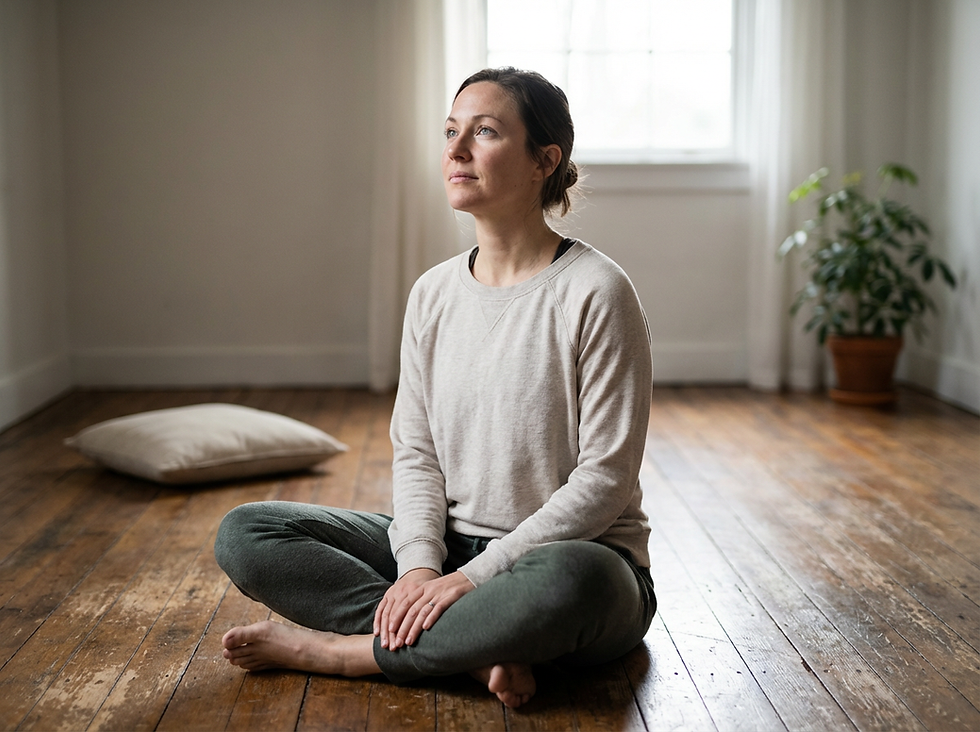
Some people find it helpful to anchor their attention in something simple. The feeling of their breath. The sensation of their feet on the ground. The sounds around them. Nothing complex. Nothing to get right. Just something steady enough to return to.
“I used to think I was bad at it,” Sarah said. “But then I realised that every time I noticed my mind had wandered and came back, that was the practice.”

That’s the part that often gets missed. Meditation isn’t the absence of thought. It’s the act of returning. Over time, something subtle begins to change. Not just during those ten minutes, but outside of them. You notice your thoughts more easily. You react a little less quickly. There’s a small gap between what happens and how you respond.
That gap is where calm begins.

There is growing scientific interest in this space. Studies have shown that even brief, regular mindfulness practices can influence areas of the brain involved in attention, emotional regulation, and stress response. Over time, this can translate into a lower baseline level of mental tension and a greater ability to manage everyday pressures. But beyond the research, the experience is simple. You feel a little less pulled.
A little more present.
“I still have the same job, the same responsibilities,” Jonas said. “Nothing about my life has really changed. But I don’t feel as caught up in it all the time.”
That’s often the difference. Not a new life. A different relationship with the one you already have. Ten minutes won’t fix everything. But it creates something important.

A moment where nothing is being asked of you.
A space where your mind doesn’t need to perform.
A break in the constant stream.
And from there, things begin to soften. The noise reduces, even slightly. The day feels more manageable. You feel more like yourself again.
At Healthier Daily, this is how we think about meditation.
Not as a technique to master. Not as a routine to perfect.
But as a small, daily return to stillness.
Ten minutes at a time.


Comments